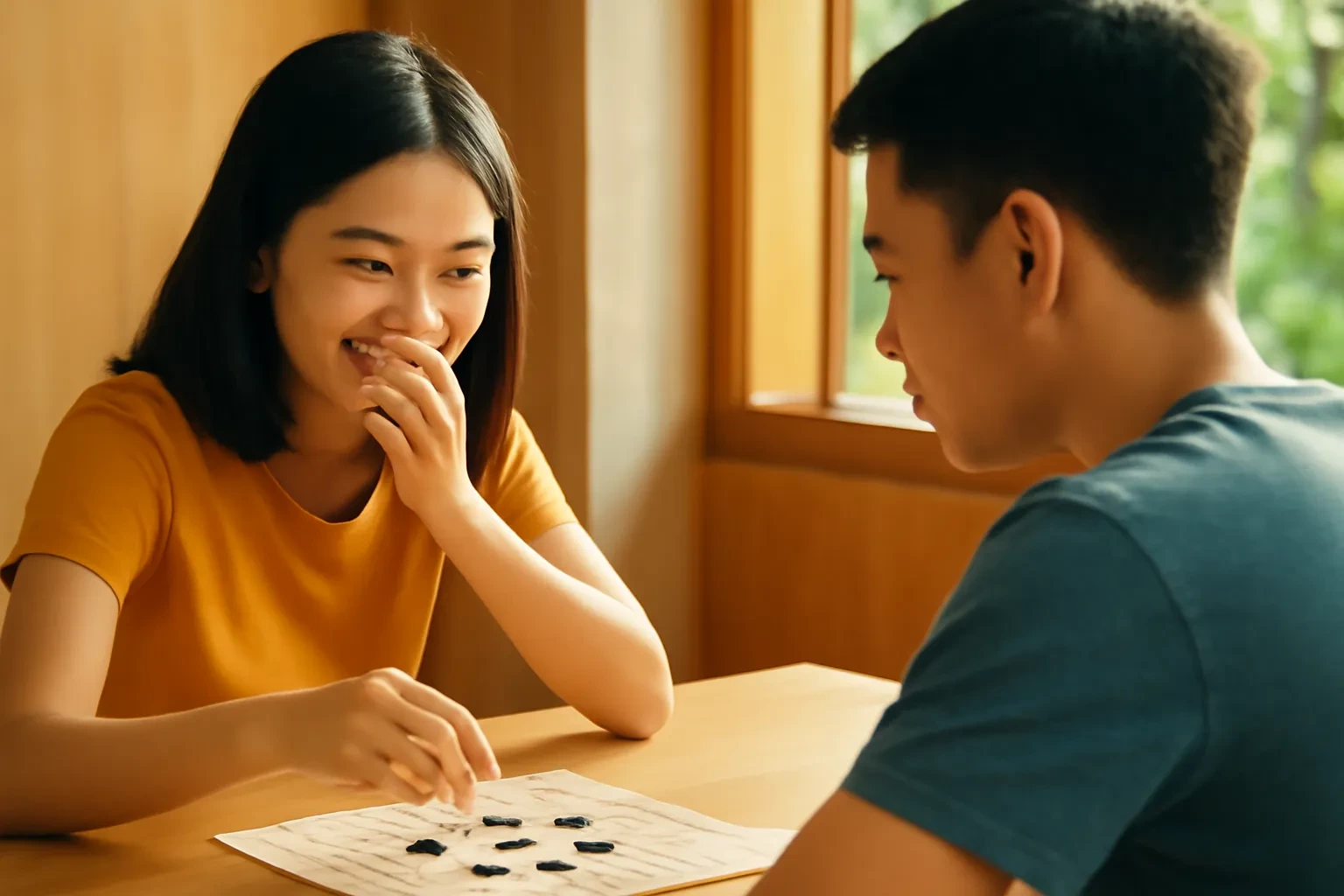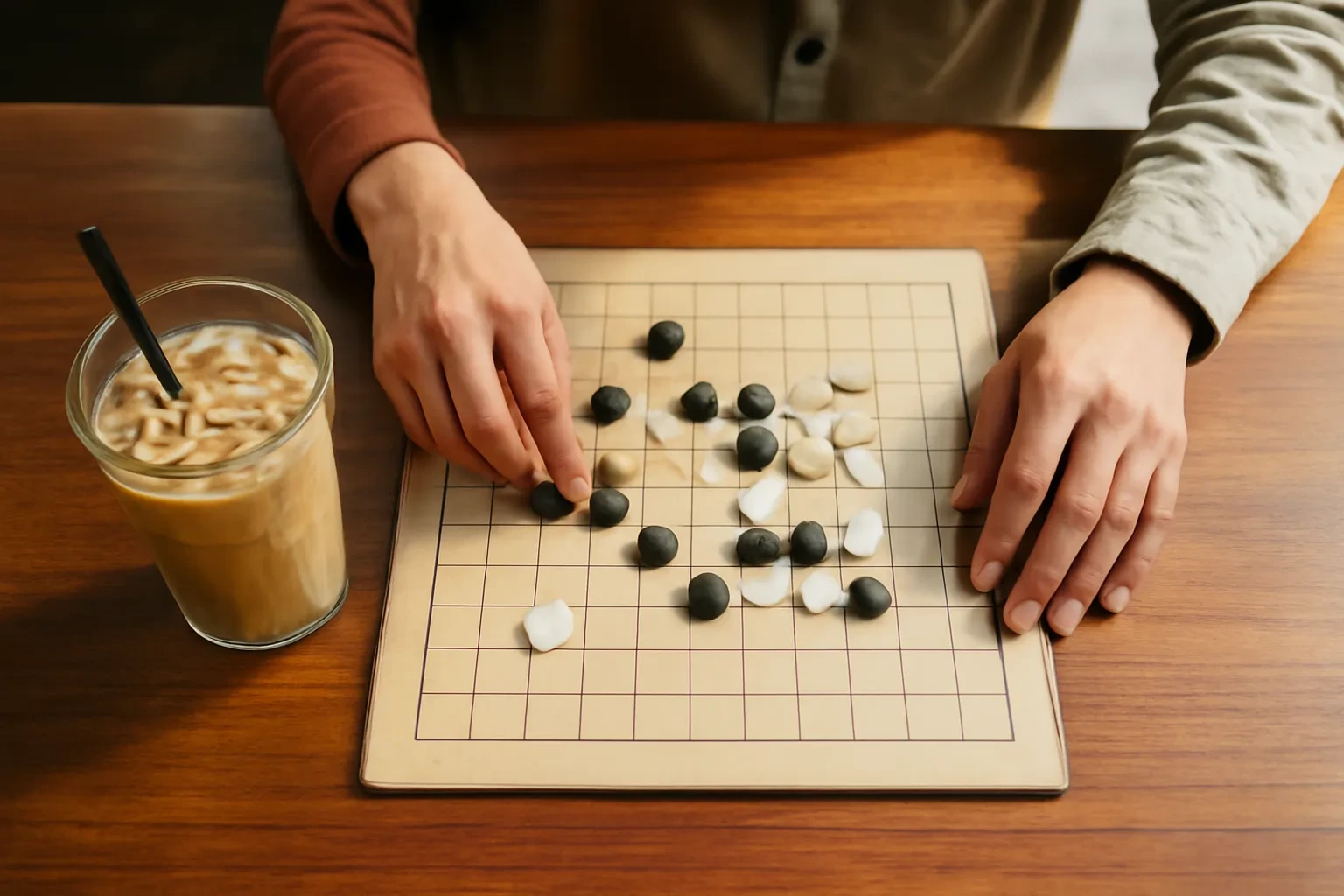
On a small notebook grid, players quickly learn that the edge of the paper matters. The same is true on this site's 15×15 gomoku board. A line that runs into the edge cannot grow in that direction, and a diagonal that starts near a corner may not have room for five stones at all. Understanding the edge gives you free defensive value, and it saves you from building attacks that can never win.
Lines need room
A five in a row needs five points. An open four needs six points (four stones and an empty point at each end), and an open three with room to become an open four needs at least seven points in a row. Near the edge, many lines simply do not have that much space.
Count it like this: if a line of yours touches the edge, the edge acts as a closed end for growth: the line cannot extend that way. A three that touches the edge is a closed three, no matter how empty the board is on the other side. A four that touches the edge is a closed four, with only one winning point.
The edge as a free blocker
When an enemy line runs toward the edge, you often do not need to block that end. The edge does it for you. Spend your stone on the other end, where the line still has room, or elsewhere entirely.
This matters most for diagonals. The diagonals near the corners are short: some have only three or four points before hitting the edge, so no five is possible on them. Stones placed there are nearly useless for attack, and enemy stones there need no attention.
The edge under the blocked ends rule
Under the Vietnamese blocked ends rule, a five does not win if both of its ends are closed by the opponent's stones. Players disagree about whether the edge of the board should count as a closed end, and house rules vary on paper. On this site the answer is fixed: the edge never counts as a block. A five that touches the edge wins unless the opponent has also closed its other end with a stone. So the edge takes away room for a line to grow, but it never makes a finished five invalid. When defending near the edge, that means you still have to block the open end yourself.
In freestyle, the question does not arise: any five wins, edge or not.
Why the centre is stronger
The centre of the board sits on the longest lines in every direction. A stone at the centre belongs to four lines that each have fourteen other points to grow into. A stone on the edge belongs to lines that are cut short on one side. That is why strong players open in the centre and why the first player's first stone is usually placed there.
A practical rule: in the opening and middle game, prefer moves within four or five points of the centre. Only go toward the edge when a specific tactic requires it.
Using the edge in attack
The edge is not always your enemy when attacking. A closed four against the edge still forces a block at its open end. If that forced block lands somewhere harmless for the opponent, you gain a tempo. Attackers sometimes build closed fours along the edge deliberately to force the opponent's stones into useless places near the border, while the real double threat is prepared closer to the centre.
Using the edge in defence
Defenders can steer the attacker toward the edge. When blocking a three, choose the end that pushes the remaining open direction toward the edge. The line may still become a closed four, but it has less room and fewer crossing lines. Over several blocks, this herds the attacker's stones into the least useful part of the board.
A small counting exercise
Pick any empty point near the edge and count, for each of the four directions, how many points the line has in total. Any direction with fewer than five points is dead for both players. Any direction with five to six points can only produce closed shapes. Doing this a few times makes the geometry intuitive.
Practice
Play the computer on the home page and deliberately start your first few stones near an edge. You will feel how much harder it is to create threats. Then play a game where you start in the centre. The difference is the best argument for central play. Related reading: diagonal vision and holding the initiative.
Edges on notebook grids
Many people learned caro on squared notebook paper, where the grid ends wherever the page ends. Those games often had irregular edges and even extra pages stuck on when the game grew. A fixed 15×15 board is tidier, and it rewards players who understand its limits. If you grew up with notebook games, expect to use the centre more on a fixed board than you did on paper, because the edge arrives much sooner.
When the edge decides a game
In close games, the edge often decides the outcome without either player noticing. A three that would have been open in the centre is closed against the edge, so the attacker's double threat fails and the defender survives. Or a defender's stone near the edge turns out to be useless, and the attacker wins with a line the defender thought was covered. Counting the room on each line before committing to an attack or a block removes most of this luck from the game.
A quick habit helps: before you celebrate a three, glance at how far each end is from the edge. If one end is two points or fewer from the border, treat the three as closed until you have checked it carefully.
One sentence to remember
The centre gives your stones room; the edge takes it away from everyone, so use it to limit the opponent and avoid it for your own lines.
Frequently asked questions
Does the edge count as a block in gomoku?
It stops a line from growing in that direction. For the blocked ends rule on this site, the edge never counts as a block: a five touching the edge wins unless the opponent has closed its other end.
Why do strong players start in the centre?
Central stones sit on the longest lines in all four directions, so they create the most possibilities.
Are corner diagonals useful?
Rarely. Many are too short to hold five stones.
Can I use the edge to attack?
Yes, by forcing the opponent's blocks into harmless places near the border while you build elsewhere.
How big is the board on this site?
The gomoku board is 15×15, a common size for the game.