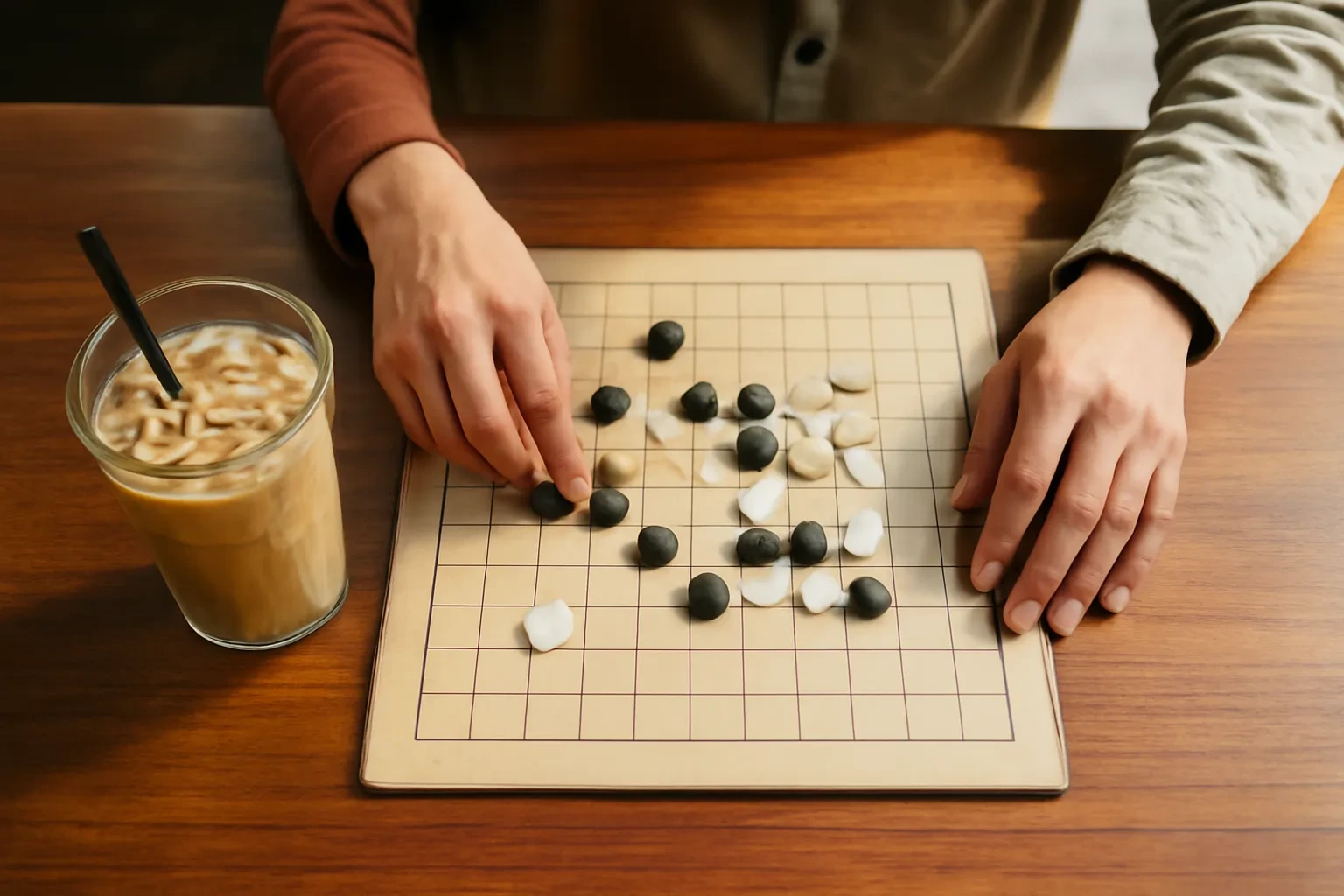
Almost every decisive moment in gomoku is a double threat: one stone that creates two threats at once, so the opponent can answer only one. Experienced players know this, so they watch for the points where two of your lines meet. The art of winning, then, is not just building a double threat but building it so that the opponent does not see it until it is too late.
Anatomy of a double threat
A double threat needs two lines that pass through the same empty point, the landing point. The most common combinations are:
- Four-three: one line becomes a four, the other an open three. The opponent must block the four, and the three becomes an open four.
- Four-four: two fours at once. Even stronger, since both must be blocked immediately.
- Three-three: two open threes at once. The opponent can block only one; the other becomes an open four. This can sometimes be answered with a counter-four, so it is slightly less reliable.
To prepare any of these, you need two lines, each short of its target by exactly one stone, crossing at an empty point.
Why obvious double threats fail
If both of your lines are already visible threes and twos pointing at the same point, a careful opponent will simply put a stone on the landing point. You lose the attack and they gain a stone in the centre of your formation. The trick is to make at least one of the two lines look harmless until the last moment.
Technique 1: the split line
A line with a gap does not look like a line. Three stones with an empty point between two of them (X, X, empty, X) is an open three, but many players do not register it as one. If your second line is a split two or split three, the landing point is less obvious.
The landing point itself can be the gap. Filling the gap completes the split line and, if another line passes through the same point, creates the double threat in one stone.
Technique 2: the forced detour
Make the opponent busy elsewhere. A forcing move on one side of the board, such as a closed four, gives them no choice about where to play. If that forced block lands far from your prepared lines, you gain a tempo without them looking at the key area. Then, on your next move, you land the double threat.
This is why fours are precious: a single closed four, played at the right moment, can buy the one move you need to complete the setup.
Technique 3: diagonals
Opponents check rows and columns more carefully than diagonals. If the second line of your double threat runs diagonally, especially through a crowded area of the board, it is far more likely to go unnoticed. See diagonal vision in gomoku for how to build and read diagonal lines.
Technique 4: stones that look defensive
A stone you place to block an enemy three looks defensive. Your opponent does not examine it the way they examine your attacking stones. If that blocking stone also sits on one of your lines, it quietly adds to your setup. After two or three such blocks, you may have a hidden two or three that the opponent never considered a threat.
The order of moves
Timing matters. When you have prepared two lines and the landing point is ready, check:
- Does the opponent have a four they can play? If yes, they will play it first, and your double threat may be one move late. Block or pre-empt it.
- Is your three really open? The edge of the board or a stray enemy stone may make it closed.
- Under the Vietnamese blocked ends rule, will your five have at least one open end? A five closed at both ends does not win under that rule.
Only then play the landing stone.
A practice routine
Double threats are easiest to learn by seeing them. Play the computer on the home page at the second or third level, and before each of your moves, name the landing points you are building toward. When you win, replay the game and find the move where your double threat first became inevitable. When you lose, find the opponent's landing point and the move where you could have occupied it.
It also helps to build double threats deliberately in a quiet corner of the board while the opponent is busy with a visible threat elsewhere. You will not succeed every time, but each attempt teaches you how lines interact, and after a few dozen games landing points start to appear to you without effort.
How strong players defend, and how to get past them
Strong opponents run a crossing test after every move: they look for empty points where two of your lines meet and occupy the most dangerous one. Against such players, a single landing point is not enough. You need two landing points at once, so that occupying one leaves the other.
Building two landing points takes patience. Usually it means placing stones that belong to three or more lines each, near the centre, and avoiding early forcing moves that commit you to one area. When the position is rich enough, the defender cannot cover everything, and one of your double threats lands.
Common mistakes when setting up a double threat
- Using up fours too early. A four played without a purpose is blocked and becomes a dead line. Keep fours for the moment they buy you the last tempo.
- Building on the edge. Lines near the edge often lack room for five, so the double threat turns out to be a single threat.
- Ignoring the opponent's threats. If they have an open three, your quiet setup move loses to their open four. Answer forcing moves first.
- Showing the landing point too early. If both lines are visible threes and twos for several moves, a careful opponent will take the point. Complete the second line as late as possible.
Frequently asked questions
What is a double threat in gomoku?
A single stone that creates two threats at once, such as a four and an open three. The opponent can only answer one.
Which is stronger, a four-three or a three-three?
A four-three is more reliable, because the four must be answered immediately. A three-three can sometimes be answered with counter-fours.
How do I stop the opponent from seeing my double threat?
Use split lines, diagonals, forcing moves elsewhere, and blocking stones that also build your lines.
Why does my double threat sometimes fail?
Usually because the opponent had a four to play first, or because your three was not truly open.
Does this site allow three-three and four-four?
Yes. There are no restrictions on double threats for either player under either rule setting.