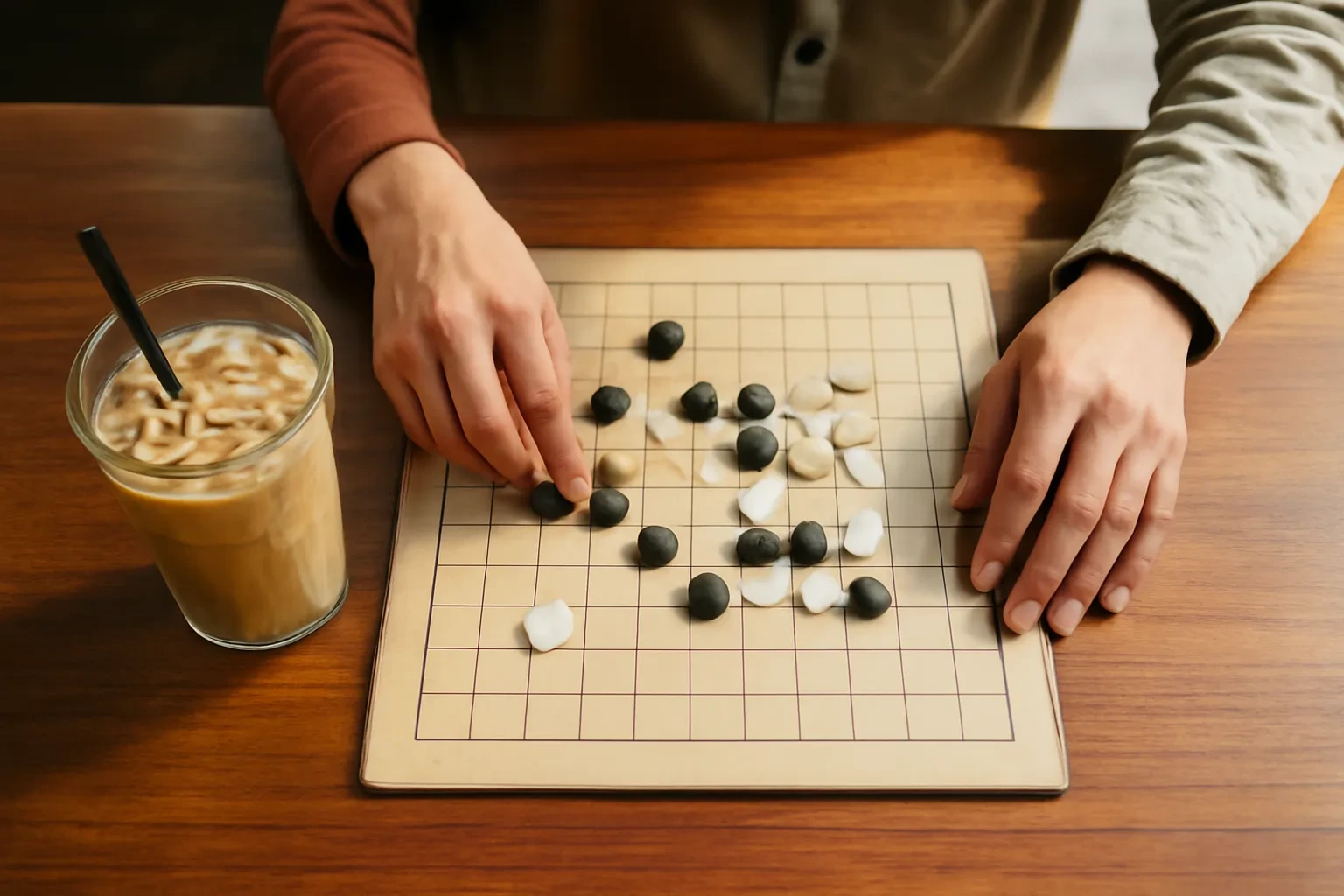
New gomoku players tend to make the same mistakes: they watch only the newest stone, they miss diagonals, and they block every visible line whether or not it matters. A handful of simple traps exploit exactly these habits. Knowing them helps you win casual games, and more importantly, it helps you stop falling into them yourself.
These traps are not secrets. They are patterns that appear naturally in games, and every experienced player has used and faced them many times.
Trap 1: the split three
A split three, with stones on three points out of four and a gap somewhere inside (for example X on g8, h8 and j8 with i8 empty), is just as dangerous as a solid three. Filling the gap makes an open four if both outer ends are open.
New players often do not recognise it because the stones do not touch. They block other lines, and when the gap is filled, it is too late.
How to avoid it: when counting a line, count stones within any five consecutive points, not only touching stones.
Trap 2: the diagonal behind the row
Build an obvious three on a row. The opponent's attention goes there and they block it. Meanwhile, two of your row stones also sit on a diagonal with a third stone. After the block, extend the diagonal. Many beginners do not check diagonals and never see it coming.
How to avoid it: after every enemy move, check both diagonals through their stones, not just the row or column that looks dangerous.
Trap 3: the forced block that helps you
Play a closed four so that the only blocking point is harmless for the opponent. They must play there. With their move used up, you have a free move to complete a second line and create a double threat.
Beginners play the forced block without thinking about why you made the four. That is exactly what makes it a trap.
How to avoid it: when forced to block, ask why the opponent played this four now. Look at what they can do with the next free move.
Trap 4: the L-shape
Place stones so that a row and a column meet at an empty corner point, each with two stones. The shape looks like an L with a missing corner. It looks harmless: two twos. But one stone at the corner creates two open threes at once. If the opponent does not occupy the corner, a three-three lands.
How to avoid it: watch for empty points where two enemy lines meet, even if each line is only a two. Those are future landing points.
Trap 5: the three that is not what it seems
Sometimes a player leaves a three that is blocked at a distance on one side, so it looks closed. But with one more stone on the other side, it becomes a split four or joins another line. Beginners who count "closed, so safe" get caught when the shape extends in the unexpected direction.
How to avoid it: a closed three is safe only for a moment. If the attacker adds a stone to it, recheck.
A worked example of the L-shape
Suppose X has stones on h8 and i8 on row 8, and on g9 and g10 on column g. The point g8 is empty and sits on both lines. Nothing looks urgent: O sees two separate twos. But if X plays g8, row 8 becomes g8, h8, i8 and column g becomes g8, g9, g10. If the ends of both lines are open, that is two open threes at once. O can block only one, and the other becomes an open four.
The defence is simple once you see it: O plays g8 first. One stone, placed a move early, breaks both lines. The difficulty is purely one of attention, which is why this shape catches so many beginners and so few experienced players.
How to build the traps yourself
To use these patterns, avoid announcing them. Spread your early stones so that each one touches two or three lines, prefer diagonal contact over side-by-side contact, and keep one or two fours in reserve. When the opponent commits to blocking an obvious line, check whether one of your quiet shapes has become an L, a split three or a diagonal three. Often it has.
Why these traps work
All five traps rely on the defender looking at the wrong thing: the newest stone, the obvious line, the visible shape. Gomoku rewards looking at the whole board: every line through every stone, and especially the empty points where lines meet.
Traps under the blocked ends rule
Under the Vietnamese blocked ends rule, a five closed at both ends does not win. This adds a sixth trap for careless attackers: building a long line between two enemy stones and expecting it to win. It will not. Defenders who know this can deliberately allow such lines and spend their moves elsewhere. In freestyle, any five wins, so this particular trap does not exist.
Practise without being a trap victim
The computer on the home page does not fall for traps the way people do, so it is a good sparring partner for learning to avoid them. Play at the second level and try to lose zero games to these five patterns. When you do lose, replay the game with undo and name the trap. Related reading: hidden double threats and diagonal vision.
A note on playing fair
Traps are part of the game, not tricks against the rules. Using them against friends is fine, and explaining them afterwards is even better: it is one of the quickest ways to help someone improve. Against children, show them the trap after the game rather than winning the same way ten times in a row; the goal is for them to enjoy playing and keep learning.
Frequently asked questions
What is the most common gomoku trap?
The split three, because the stones do not touch and many players do not count it as a three.
Are traps unsportsmanlike?
No. They are normal tactics. Explaining them afterwards is a friendly way to help others improve.
Does the computer fall for traps?
Rarely. It checks every line equally, which makes it good practice for avoiding traps yourself.
How can I stop missing traps?
Scan all four directions from every enemy stone, and watch the empty points where two enemy lines meet.
Does the blocked ends rule create new traps?
Yes. A long line trapped between two enemy stones does not win under that rule, which catches players used to freestyle.