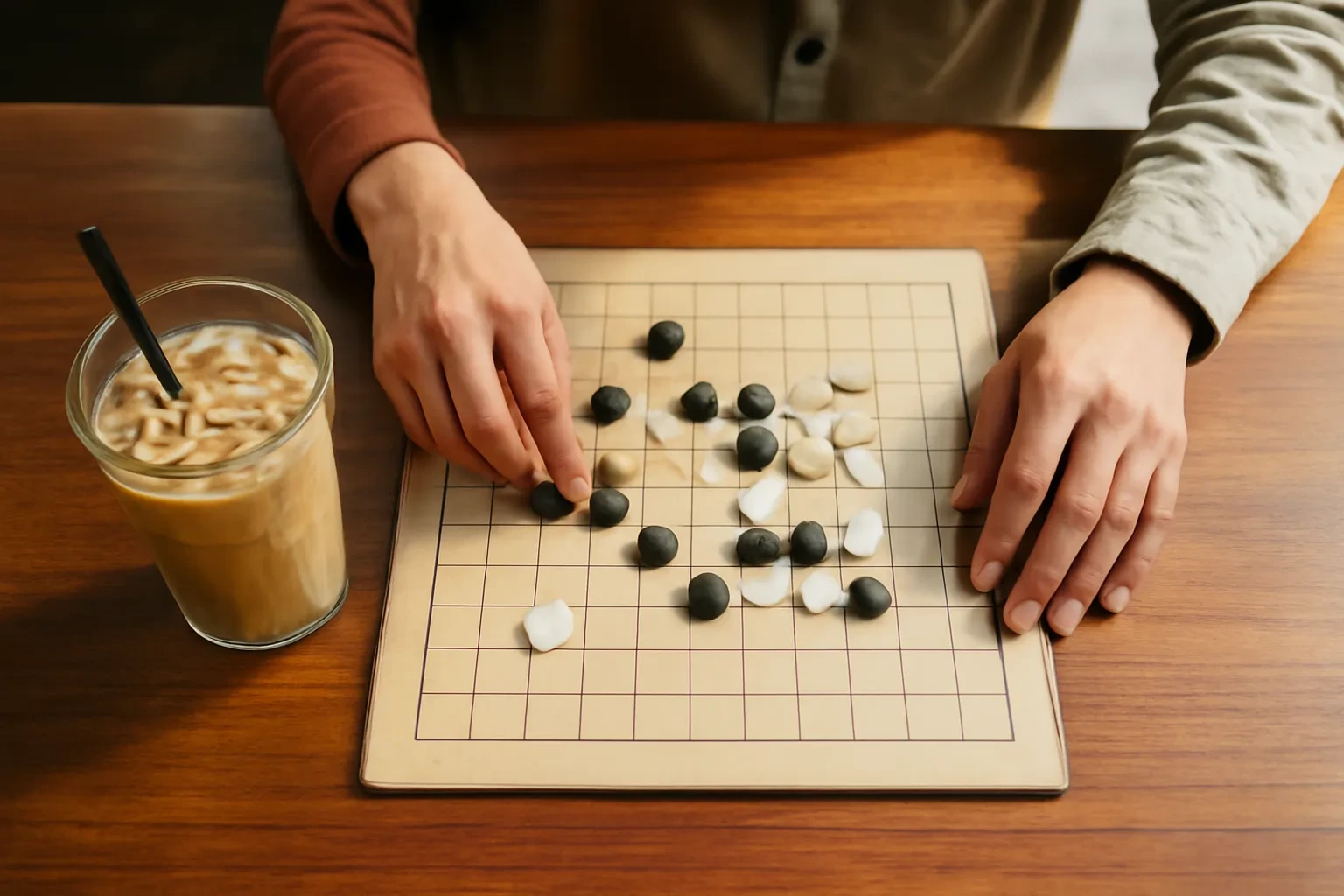
Gomoku rewards momentum. Once one player starts making threats the other must answer, the game often ends a few moves later with a double threat. The player making those threats holds the initiative. Learning to take it, hold it and convert it is the most direct path to winning more games, and it is a skill built from a few simple ideas.
Forcing and quiet moves
A move is forcing when the opponent must answer it or lose immediately. In gomoku there are two kinds:
- A four: threatens to make five next move. It must be answered at once.
- An open three: threatens to make an open four next move. It must be answered unless the opponent has a four of their own.
Everything else, such as twos, closed threes and building moves, is quiet. A quiet move lets the opponent choose freely what to do next.
Chains of forcing moves
The strongest attacks are chains: a forcing move, a forced answer, another forcing move, another forced answer, until one of your moves creates two threats at once. Because the answers are forced, you can predict them and plan the chain several moves ahead.
A simple chain looks like this:
- Make a closed four. The opponent must block its only open end.
- Use one of the four's stones to make an open three on a different line. The opponent must block it.
- Use the new stone to make another four that also completes a three on a third line. That is a four-three, and the game is over.
The key feature is that each forcing stone also builds something. A four that only threatens is blocked and becomes a dead line.
Fours are a limited resource
Every closed four becomes harmless once blocked. Beginners often play a four the moment it appears, even with no follow-up; the opponent blocks, and a weapon is gone. Keep fours in reserve for two purposes: to start or continue a chain that ends in a double threat, or to defend when the opponent has a threat you cannot otherwise answer.
Reading the opponent's forced answers
Forced answers are predictable, and that is what lets you plan. A closed four has exactly one blocking point. A solid open three usually has two sensible blocks. Before starting a chain, imagine each forced answer on the board and ask whether it helps the opponent. A forced block is still a stone: if it happens to complete one of their lines, your chain has just handed them a threat. Strong attackers check this at every step.
When a quiet move is right
Sometimes you hold the initiative but no chain ends in a win. Then a well-placed quiet move can be stronger than a forcing move that goes nowhere. The best quiet moves create several future threats at once, so that next turn you will have more than one chain available. The opponent, with a free move, can break one of them but not all.
The danger of a quiet move is that it gives the opponent a free turn. Before playing one, check that they have no forcing chain of their own.
How the initiative is lost
- A forcing move with no follow-up. You make a three, it is blocked, and you have nothing next.
- A quiet move at the wrong moment. The opponent uses the free move to start their own chain.
- Racing a three with a three. They already have an open three; you make one too; they make an open four and win.
Converting a winning position
Holding the initiative is not the same as having won. Many games are thrown away in the last few moves, when the attacker is excited and plays too fast. Once you see a double threat coming, check three things:
- Does the opponent have a four they can play first? If so, your double threat may arrive one move too late.
- Is your three really open, with room at both ends? A stray enemy stone or the lack of space near the edge can make it closed.
- Under the Vietnamese blocked ends rule, will your final five have at least one end not closed by an opponent stone? On this site the board edge never counts as a block, so a five running into the edge is fine as long as the opponent has not closed its other end.
Only when all three pass should you play the winning move.
The blocked ends rule and forcing moves
Under blocked ends, a five closed at both ends by the opponent's stones does not win. Some fours are therefore weaker than they look: a four whose only completion would be a doubly closed five is not a real threat, and the opponent may ignore it. Before counting a four as forcing, check that the final five would have at least one end free of enemy stones. In freestyle, every four is forcing.
Initiative and moving first
X moves first and starts with a small natural advantage, and on this site there are no extra restrictions on the first player. When you play X, the goal is to turn that head start into a forcing chain before O catches up. When you play O, neutralise it: block efficiently, build as you block, and strike at the first quiet move.
A one-line summary
Force when forcing builds, build quietly when it creates several threats, and never let a quiet move hand the opponent a free chain of their own.
Practise
The computer on the home page at the third level gives you room to experiment with chains. Try to win each game with a chain of at least three forcing moves, and when it fails, use undo to find where the chain broke. Related reading: hidden double threats and diagonal vision.
Frequently asked questions
What does initiative mean in gomoku?
Being the player whose moves force answers. That player decides where the game goes.
Should I always play a four when I can?
No. A four without a follow-up is wasted once blocked. Keep fours for chains or for defence.
Is an open three always forcing?
Yes, unless the opponent has a four to play first.
How do I get the initiative back as the defender?
Answer forcing moves accurately with blocks that build your own lines, then strike when the attacker plays a quiet move.
Does the board edge make a five invalid under blocked ends?
Not on this site. The edge never counts as a block; only opponent stones at both ends make a five invalid.