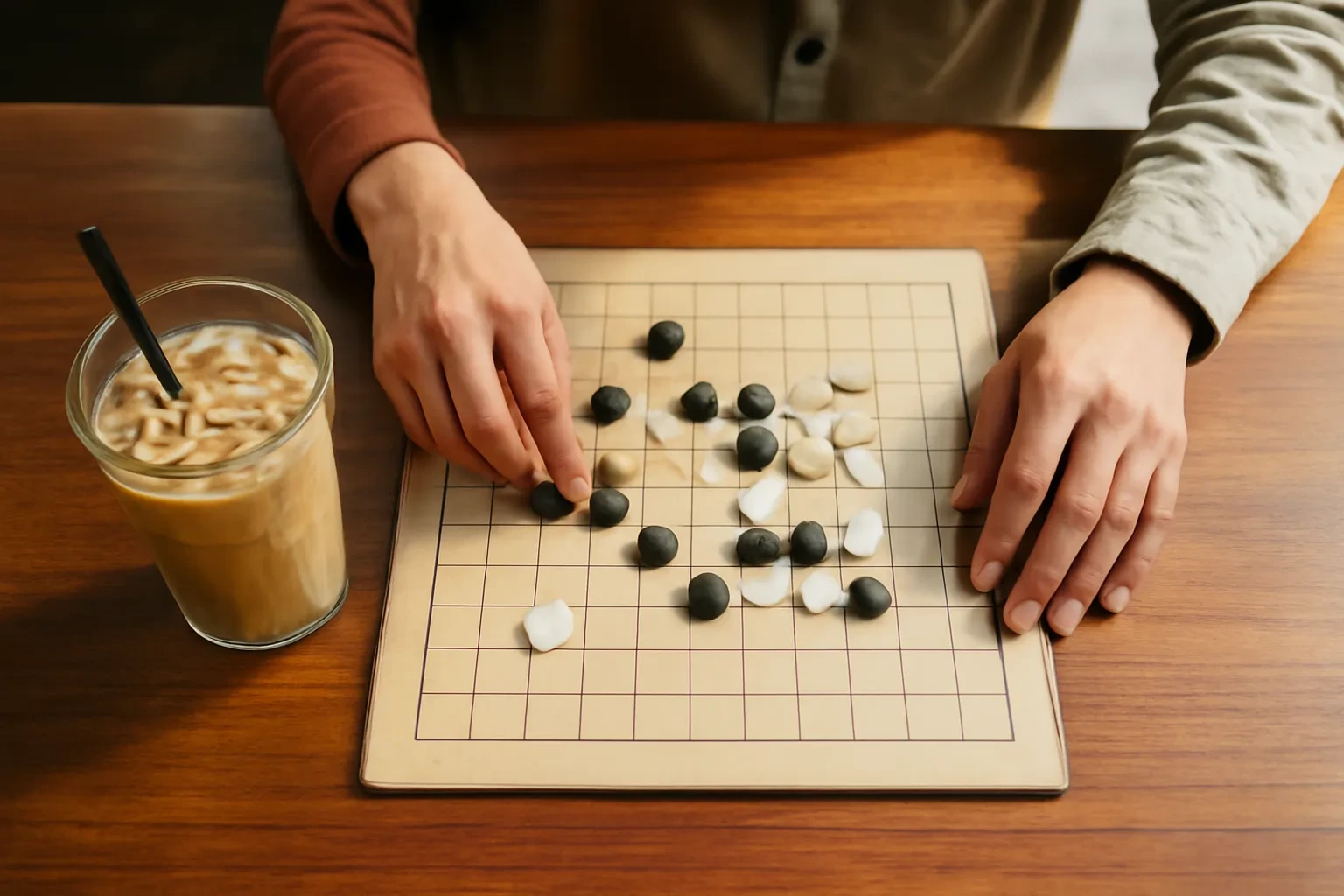
Ask a group of gomoku players where they lost their last game and many will point to a diagonal. It is not that diagonals are stronger than rows or columns. A line of five is a line of five in any direction. The difference is in how people see. Our eyes follow horizontal and vertical lines easily and skip over diagonals, especially on a dense board or a small phone screen. That weakness, in your opponents and in yourself, is something you can use.
Why diagonals are hard to see
A horizontal line of stones sits on one row: the eye can take it in with a single glance. A diagonal line jumps one row and one column at every step. On a grid full of stones, the diagonal neighbours of a stone are surrounded by other stones on the rows and columns in between, and the pattern breaks up visually.
The result is predictable. Players count their opponent's rows and columns carefully and check diagonals only sometimes. A three on a diagonal survives longer than a three on a row, and a four on a diagonal is more often missed completely.
Building on diagonals on purpose
Because diagonals are seen late, they make excellent places to prepare double threats. A common approach:
- Build a visible threat on a row or column. The opponent's attention goes there.
- Place your stones so that the row stones also sit on a diagonal with other stones of yours.
- When the opponent blocks the row, extend the diagonal. Often it is already a three by then, and the opponent has not noticed it forming.
This is not a trick that works against strong players every time, but it works far more often than an attack built entirely on rows.
The knight-step pattern
A useful shape for diagonal play is two stones a knight's move apart (two points in one direction, one in the other). Such a pair is not on any common line yet, but the two points that would connect them lie on a row or column with one stone and a diagonal with the other. Placing a stone on either connecting point gives you twos in two directions at once. From there, threes and double threats come naturally.
Diagonals near the edge
Diagonals get shorter near the corners of the board. A diagonal that starts two points from the edge simply does not have room for five stones plus open ends. Keep this in mind both ways: do not waste stones building a diagonal that cannot become five, and do not waste blocks on an enemy diagonal that the board edge already limits. Note that under the Vietnamese blocked ends rule on this site, the edge of the board never counts as a block: a five that runs into the edge still wins unless the opponent has closed its other end. The edge limits room, not validity.
Training your eyes
Seeing diagonals is a skill you can practise directly:
- Diagonal-only scan. For one full game, after every opponent move, check both diagonals through their new stone before anything else. It feels slow for a game or two, then it becomes automatic.
- Replays. Replay your lost games and mark every diagonal threat. You will often find the diagonal was visible for several moves before it won.
- Finger tracing. On a phone, trace the diagonal with a fingertip above the screen. It sounds silly, but it helps the eye follow the line.
- Rotate your view. Some players imagine the board turned forty-five degrees so that diagonals become rows. It takes practice, but it works.
Using diagonals in defence
Diagonal awareness also changes how you block. When the opponent threatens on a row, look for a blocking point that also sits on one of your diagonals. Because the opponent is also weak at diagonals, a defensive stone that builds a quiet diagonal line often turns into a surprise three a few moves later.
Diagonals against the computer
The computer on the home page does not have human blind spots: it checks every direction equally. That makes it an honest training partner. If you can build winning diagonal attacks against the third or fourth level, those attacks will be even more effective against people. Conversely, when the computer beats you on a diagonal, use undo to find the move where the diagonal first became a three. It is almost always earlier than you think.
How diagonals change the opening
In the first few moves of a game, many players place stones next to each other on a row or column because it feels natural. Stronger players often start with diagonal contact instead: the second stone touches the first at a corner rather than a side. This keeps more lines available for both stones and makes the shape harder for the opponent to read. It also means that the first real threat of the game is more likely to appear on a diagonal, where the opponent is least prepared.
You do not need to memorise openings to use this. Simply prefer diagonal contact when you have a free choice early on, and notice how often your later threes appear on lines the opponent did not watch.
A quick diagonal checklist
Before you place any stone in the middle game, run through these questions:
- Does the opponent have three or more stones within five points on either diagonal through their last move?
- Do I have a diagonal two or three that my next stone could extend?
- Is my intended stone also on a diagonal with any of my other stones?
The third question is the one that turns ordinary moves into hidden attacks.
Diagonals on a phone screen
On a small screen, stones look closer together and diagonals are even harder to follow. Zoom is not available on every board, so it helps to hold the phone a little further away when scanning the whole position, then closer when placing a stone. Playing in landscape, if your phone allows it, also gives the grid more room.
Frequently asked questions
Are diagonal lines worth the same as rows in gomoku?
Yes. A five on a diagonal wins exactly like a five on a row or column.
Why do I keep losing to diagonals?
Because the eye follows rows and columns more easily. Add a separate diagonal check to your scan after every move.
Do diagonals work near the corners?
Only if there is room for five stones. Short diagonals near the edge cannot become five, so do not waste stones there.
Does the computer miss diagonals like people do?
No, it checks every direction equally, which makes it good practice for your own diagonal vision.
How can I hide an attack on a diagonal?
Draw attention with a threat on a row or column, and prepare the diagonal with the same stones.