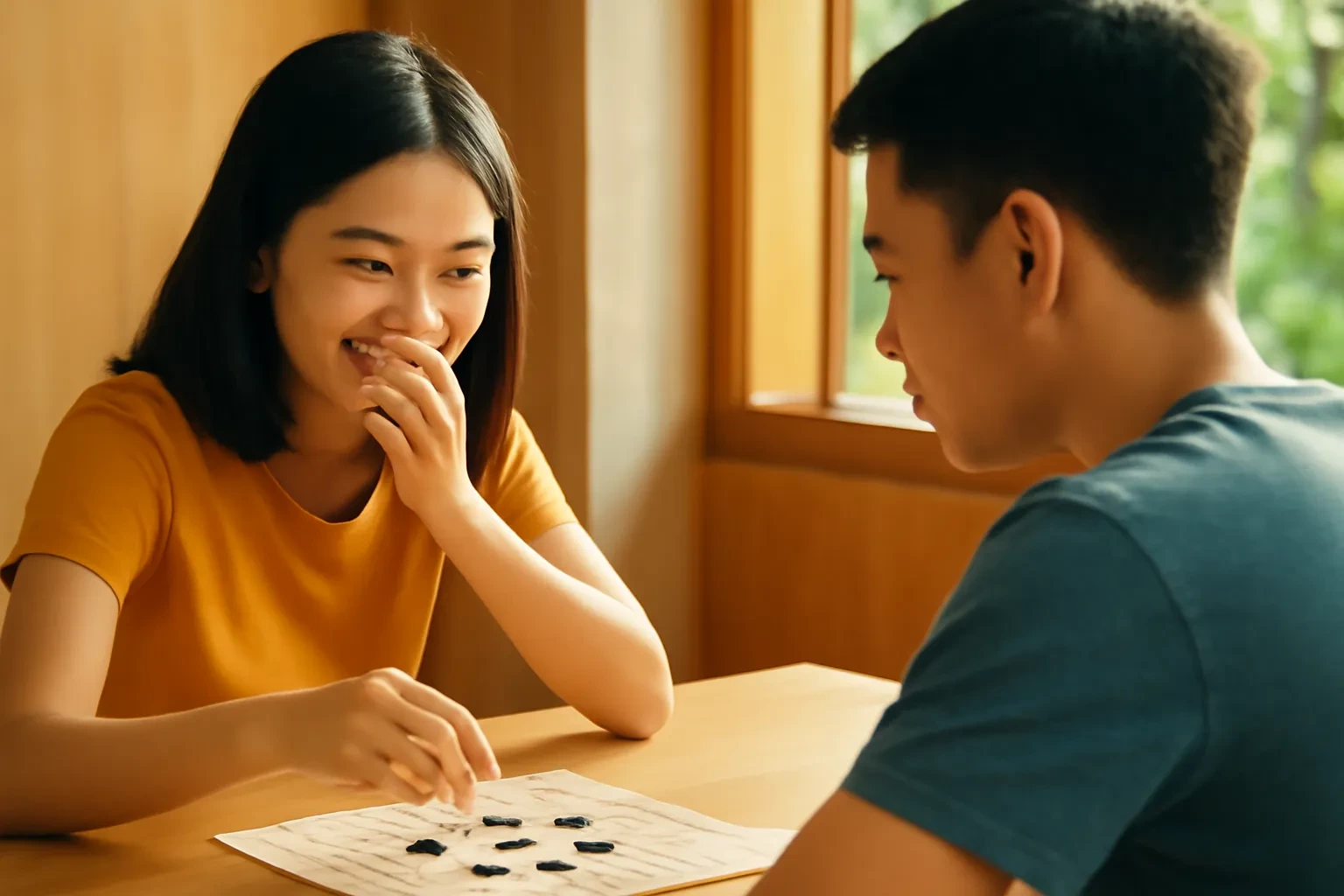
Every gomoku player eventually meets someone clearly stronger: a friend who wins nine games out of ten, an online opponent who seems to see everything, or the fourth level of the computer. It is tempting to look for a secret trick that will beat them. There are no secret tricks that reliably beat good players. What works is a set of habits that removes your usual mistakes, forces them to work harder, and takes the chances they do give.
Stronger players win on your mistakes
Watch a strong player beat a weaker one and you will usually see the same pattern: a steady pressure of small threats, then a double threat that lands because the weaker player missed a crossing point or a diagonal a few moves earlier. The winning move looks brilliant, but it was prepared by the loser's oversight.
So the first step in beating stronger players is not attack. It is making fewer mistakes. Every crossing point you take, every diagonal you check, every split three you notice is one path to victory closed for them.
Habit 1: slow down at the right moments
Strong players are fast in quiet positions and slow in critical ones. Weaker players are often the opposite: they think hard about the opening and then play instantly when the board gets crowded. Reverse that. Spend your time when there are many stones in the centre and threats are near, not in the first few moves.
Habit 2: defend with purpose
Against a strong attacker you will spend many moves defending. Make each block count by choosing the end or point that also builds your lines. After several blocks, you will have a structure of your own, and the moment the attacker plays a quiet move, you can strike. Read more in counterattack from defence.
Habit 3: keep your fours
Your fours are your emergency tools. When a strong opponent builds a double threat you cannot stop, a chain of your own fours is the only way to survive or turn the tables. Players who spend their fours early have nothing left at that moment.
Habit 4: aim for complexity
Strong players convert simple advantages efficiently. Complicated positions with many lines crossing near the centre give more chances for anyone to go wrong, including them. When you are behind, prefer moves that add lines and crossings over moves that simplify.
Habit 5: learn from every loss
Losing to a stronger player is the best lesson available, but only if you look at why. After each loss, find three moments: where the opponent's decisive double threat was first prepared, where you could have occupied the landing point, and where you spent a move on a harmless block. Those three moments tell you exactly what to practise.
If you sign in on the account page, your games are saved, and you can replay them move by move.
Habit 6: know the shapes they will use
Stronger players have favourite patterns. Some love building along diagonals, some prefer the L-shape that turns into a three-three, some rely on long chains of closed fours. After a few games against the same opponent, you will notice their preferences. Write them down if it helps. Once you know that a friend always prepares a diagonal behind their row threats, you will start checking that diagonal automatically, and a large share of their wins will disappear.
Habit 7: play the opening on your terms
In the first few moves, stronger players quickly build flexible shapes near the centre. If you place your early stones far from theirs, you give them a free hand. Stay close: place stones that touch their stones diagonally, so that each of your moves limits one of their lines while starting one of yours. You will not win the opening, but you will prevent them from winning it by a large margin, and a close middle game is where upsets happen.
What a good result looks like
Against a much stronger player, winning one game in five is real progress. Losing slowly, with long games full of accurate defence, is progress too, because it means they had to find a genuinely clever idea to beat you. Measure improvement by how long and how difficult your games are, not only by wins. The wins follow.
Psychology at the board
Stronger players are human too. They get impatient when a game drags on, they sometimes relax when ahead, and they occasionally underestimate a quiet position. Staying calm and continuing to defend accurately after a bad start often produces a chance later. Do not resign early in casual games; the ending is often where upsets happen.
Using the computer as a stronger opponent
The fourth level of the computer on the home page is a reliable stand-in for a stronger player. It does not tire, does not relax and does not miss diagonals. Beating it even occasionally means your habits are sound. A good training cycle is to play five games, review each loss with undo, and focus the next five games on the single most common mistake you found.
Choosing the rule setting
If you often play the same stronger friend, try both rule settings on the site: the Vietnamese blocked ends rule and freestyle. Under blocked ends, attacks need more care because some fives do not count, and players who are strong at freestyle sometimes struggle with it. A different rule set can level the field and teach both of you something.
A short checklist for your next game against a stronger player
- Take crossing points before they become landing points.
- Check both diagonals after every one of their moves.
- Keep at least one four in reserve.
- Slow down when the centre gets crowded.
- After the game, find the move where their winning idea began, and practise that shape.
Frequently asked questions
Is there a trick that always beats stronger gomoku players?
No. Consistent defence, careful attention to crossing points and diagonals, and good timing close the gap more than any trick.
Should I play defensively against a stronger player?
Defend accurately, but always with blocks that build your own lines, so you are ready to counterattack.
When should I spend my thinking time?
In crowded, critical positions near the centre, not in the first few moves.
How can I practise against stronger opponents?
Use the higher computer levels and review every loss to find the move where the decisive threat was prepared.
Does switching rules help?
Sometimes. The blocked ends rule changes which attacks work and can surprise players used to freestyle.