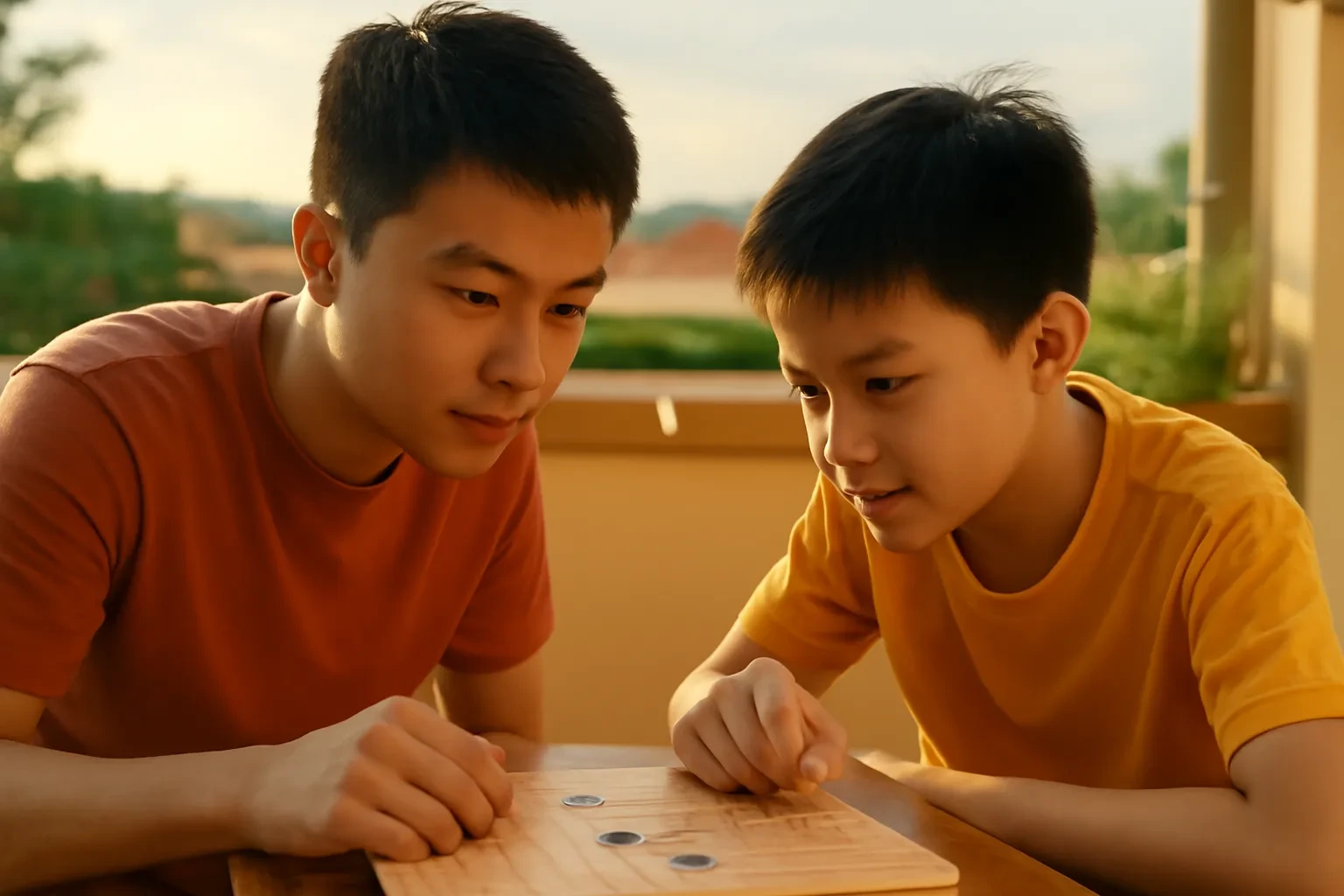
Every gomoku player makes the same handful of mistakes at the start. They are not signs of a lack of talent; they are simply what the human eye does on a grid before it has been trained. The good news is that each one has a concrete fix, and fixing even two or three of them will change your results within a week.
Here are the ten we see most often, grouped into mistakes of vision, defence and attack.
Vision mistakes
1. Missing diagonals
The most common beginner loss of all. The eye tracks rows and columns naturally; diagonals take deliberate effort. An opponent builds three marks on a diagonal, and the beginner simply does not see them until they become four.
Fix: after every opponent move, check all four lines through the new mark, and check the diagonals first, because they are the ones you are most likely to skip.
2. Looking only at your own line
Many beginners play "their" game: they pick a line and push it, ignoring what the opponent is doing. Gomoku does not work that way. Every opponent move can create a threat you must answer.
Fix: before choosing your own move, always ask "what did their last move threaten?"
3. Counting wrong
Beginners often misjudge whether a line has three or four marks, or whether there is a gap. The result is either panic over a harmless line or calm over a deadly one.
Fix: count from the newest mark outward in both directions, stopping at the first empty point or opponent mark. Add the two counts and the mark itself.
Defence mistakes
4. Ignoring open threes
An open three with empty space at both ends becomes an open four in one move, and an open four cannot be stopped. Beginners often think "it's only three" and play elsewhere.
Fix: treat every open three as urgent. Block it, unless you can make a four of your own first. See open and closed threes.
5. Blocking the wrong end
When you block an open three, the end you choose matters. One end may also block another of the opponent's lines, or leave them with less room; the other end may leave a gap that they can still exploit.
Fix: before blocking, look at both ends and pick the one that does the most. If one end also sits on another enemy line, that is usually the better block.
6. Blocking too far away
Some players block an open three by placing a mark one point beyond the end, leaving a gap. Against a broken shape this can fail, because the attacker may still make a four through the gap.
Fix: block directly against the line unless you have a clear reason to do otherwise.
Attack mistakes
7. Building toward walls
A line growing toward the opponent's marks or the edge of the board has less room to become five. Beginners often extend in whichever direction is closest, not whichever is most open.
Fix: before extending a line, check how much empty space lies in that direction. Grow toward open space.
8. Wasting fours
Making a four forces your opponent to block at one specific point. That is useful when the forced reply helps you — but many beginners make fours just because they can, and the opponent's forced block often lands somewhere helpful to them. Under blocked-ends rules this is even worse, because a four blocked at its only open end becomes dead.
Fix: only make a four when you gain something from it: either an immediate win, or a forced reply that sets up your next threat.
9. One threat at a time
A single threat can always be blocked. Games are won with moves that create two threats at once, such as a four and an open three together.
Fix: look for crossing points, where one mark extends two of your lines. Read about the four-three to see the classic winning pattern.
10. Playing too fast
Gomoku feels fast, so beginners play fast — especially online with a clock. But the decisive mistake in most games happens on a move that took two seconds.
Fix: you do not need to think long on every move, but always take the few seconds to check all four lines through the opponent's last mark.
Why these mistakes happen together
Most of the ten come from one root cause: attention on your own plan instead of the whole board. When you are excited about your own attack, you stop reading the opponent's threats and you stop checking where your line has room to grow. Strong players are not immune to this; they have simply built habits that force them to look.
A quick self-check after each game
After every game, win or lose, ask three questions:
- Did I lose (or nearly lose) to a line I did not see? Which direction was it?
- Did I block an open three at the best end?
- Did I make at least one move that helped two of my lines?
Write the answers down for a week. You will see your own pattern quickly — most players have one or two favourite mistakes rather than all ten.
One mistake, two players
It is worth noticing that most of these mistakes come in pairs. When you ignore an open three (mistake 4), your opponent is usually avoiding mistake 9 — they built a threat you had to answer. When you waste a four (mistake 8), your opponent gets a free block that may land on one of your other lines. Gomoku is a game of tempo: every move either creates a problem for the other player or solves one of yours. Beginners lose tempo without noticing, and a few lost tempi add up to a lost game.
A useful way to think about it: at every moment, one player has the initiative — they are making threats, and the other is answering. Your aim as a beginner is simply to notice who has it. If it is the opponent, answer their threats accurately. If it is you, make sure each threat you create also prepares the next one. The article on keeping the initiative develops this idea further.
Practice suggestions
- Play the easiest computer level on the home board and say out loud every open three you see.
- Replay your lost games from your account and mark the move where the losing line became an open three.
- Once you stop losing to diagonals, switch to blocked ends and watch how often your wasted fours now cost you the whole line.
Frequently asked questions
Which beginner mistake costs the most games?
Missing diagonal lines, followed by ignoring open threes.
How long do these mistakes take to fix?
Vision mistakes improve within a few dozen games of deliberate checking. Attack habits take longer, because they require seeing double threats.
Should I always block an open three?
Almost always, unless you can make a four of your own that forces the opponent to answer first.
Are these mistakes different in Vietnamese caro?
They are the same mistakes, but wasted fours are even more costly under blocked-ends rules, because the forced block can kill your line permanently.