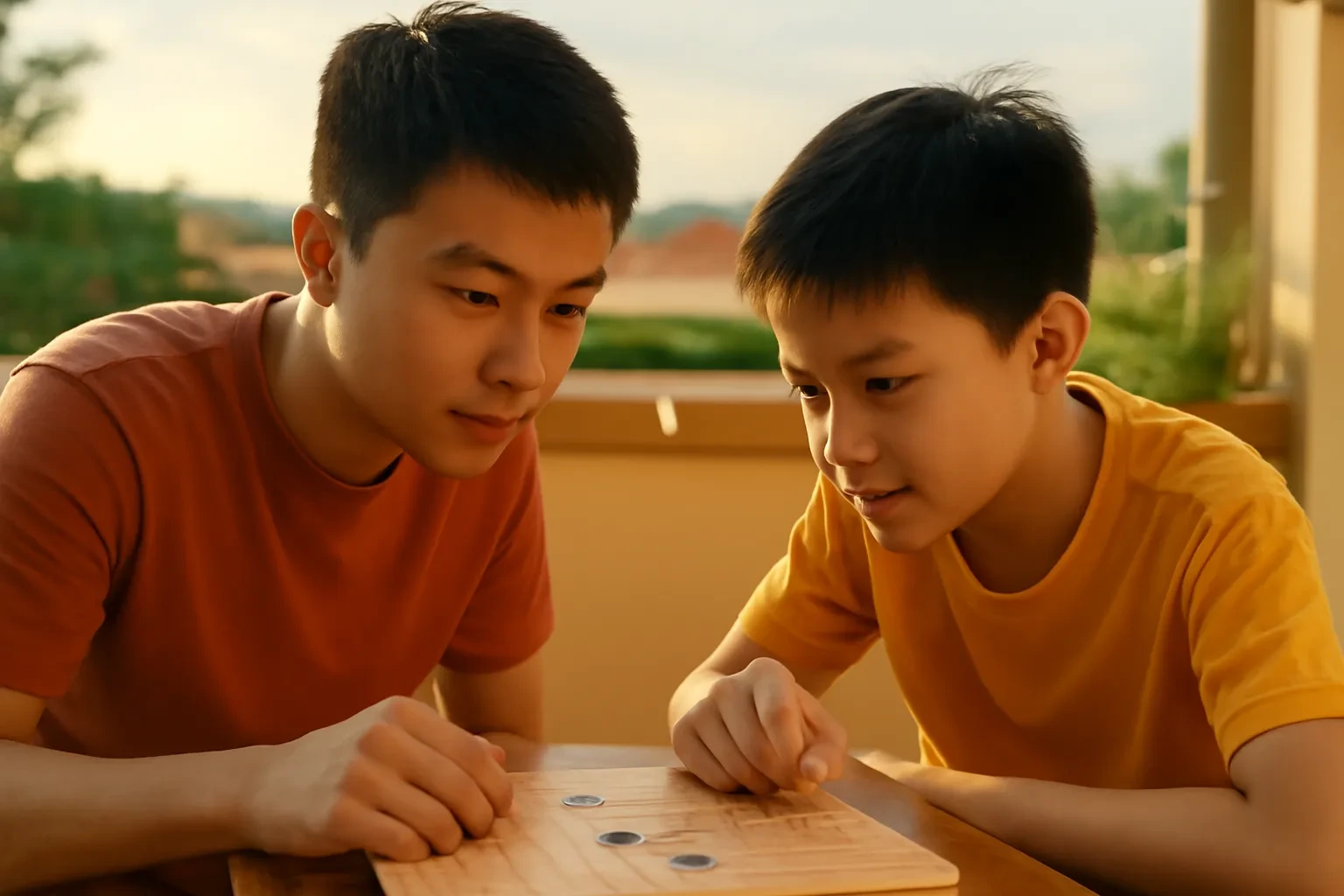
Playing a lot of games helps, up to a point. After that, many players stop improving, even though they keep playing. The difference between players who keep getting better and those who plateau is not talent or hours — it is how they practise.
This article covers three kinds of practice that work, all of which you can do for free on this site: deliberate games, game review, and short drills.
1. Deliberate games
A deliberate game is one where you decide in advance what you are practising. Instead of "play and see what happens", you set a single focus:
- "This game, I will check all four lines through every computer move."
- "This game, I will block every open three at the better end."
- "This game, I will make at least two moves that help two lines at once."
One focus per game is enough. The computer on the home board is ideal for this because it is always available, never impatient, and lets you take moves back with the undo button.
Using undo well
Undo is a training tool, not a cheat. Use it in two situations:
- When you notice a mistake straight away. Take it back, think about why it was wrong, and play the better move. You are building the right habit.
- When you lose. Step back to the move where the losing threat appeared and try a different defence. See whether it holds.
Avoid using undo to "save" every game automatically. If you undo without thinking, you learn nothing.
Choosing the level
Pick a computer level where you win roughly half your games. Too easy and you learn nothing about defence; too hard and every game ends before you can practise your focus. Raise the level when you win comfortably.
2. Replaying your games
Your own games are the best teaching material you will ever have, because they show exactly what you miss. If you sign in to your account, your games are saved and you can replay them one move at a time.
A simple review routine for a lost game:
- Find the end. Which line won? Mark it mentally.
- Go back until it was an open three or a broken three. That was probably your last comfortable chance to stop it.
- Go back a little further. Was there a move where the opponent placed a mark on two of their lines at once? That was where the danger was created.
- Ask what you were doing at that moment. Often you were pushing your own line and not watching theirs.
For a won game, the same routine works in reverse: find the move where you created two threats at once, and ask how you could have found it earlier.
Five minutes of review after a session is worth more than five extra games.
3. Short threat drills
Drills train your eyes to recognise shapes instantly. You can make your own with pencil and squared paper, the way generations of Vietnamese students did with caro in their school notebooks.
Drill A — Find the threat. Draw a small position with a few marks for each side. Ask: does either player have an open three, a four or a broken three? Where is the point that completes it?
Drill B — Find the double. Draw a position where one side has two lines of two or three that cross near an empty point. Find the point that makes a double threat.
Drill C — Choose the block. Draw an open three for the opponent with other marks nearby. Decide which end to block and why.
Five minutes of drills a day, especially Drill A, will speed up your threat reading more than anything else.
Playing people
The computer is excellent for deliberate practice, but people are more varied. They make unusual moves, fall for different traps and attack in styles the computer does not. Once you are comfortable, add some online games. Between people there is no chat — just the game — and you can invite a friend with a link if you prefer a familiar opponent.
After an online game, review it the same way: find the moment the decisive threat appeared.
A weekly rhythm
A balanced week might look like this:
- Four days: 15 minutes of deliberate games against the computer, one focus per session.
- Two days: 10 minutes of review of the week's lost games, plus 5 minutes of drills.
- One day: free play online, just for fun.
Adjust to your schedule. Consistency matters more than volume.
Setting a measurable goal
Practice feels more rewarding when you can see progress. Instead of vague goals like "get better", set small measurable ones:
- "No losses to unseen diagonals this week."
- "At least one four-three per game against the second computer level."
- "Win three games in a row as O on the easiest level."
When you reach a goal, set the next one slightly harder. Small, clear targets keep practice focused and make it easy to notice when a habit has become automatic.
Practising with a friend
If you have a friend who also wants to improve, play a few games together and then review them side by side. Each of you explains what you were thinking at the key moments. You will be surprised how often one player saw a threat the other completely missed. Invite your friend with a link from the online page so you can play from different places, then compare notes afterwards.
One rule makes these sessions much more useful: the winner explains the winning combination. Putting it into words forces you to understand exactly why it worked, and your friend learns it at the same time.
Common practice mistakes
- Only playing, never reviewing. You repeat the same mistakes.
- Only playing the easiest level. You win a lot and learn little about defence.
- Practising too long. Tired practice builds bad habits. Stop while you are still concentrating.
- Changing focus every game. Stick with one skill for a few days until it feels natural.
Frequently asked questions
Do I need a coach to improve at gomoku?
No. Deliberate practice, game review and drills will take you a long way on your own.
Is playing the computer good practice?
Yes, especially for deliberate practice, because you can take moves back and repeat situations.
How often should I review my games?
A few times a week is enough. Focus on lost games first.
What is the single best drill?
Finding the threat in a small position. It trains the most important skill in the game: seeing lines instantly.